
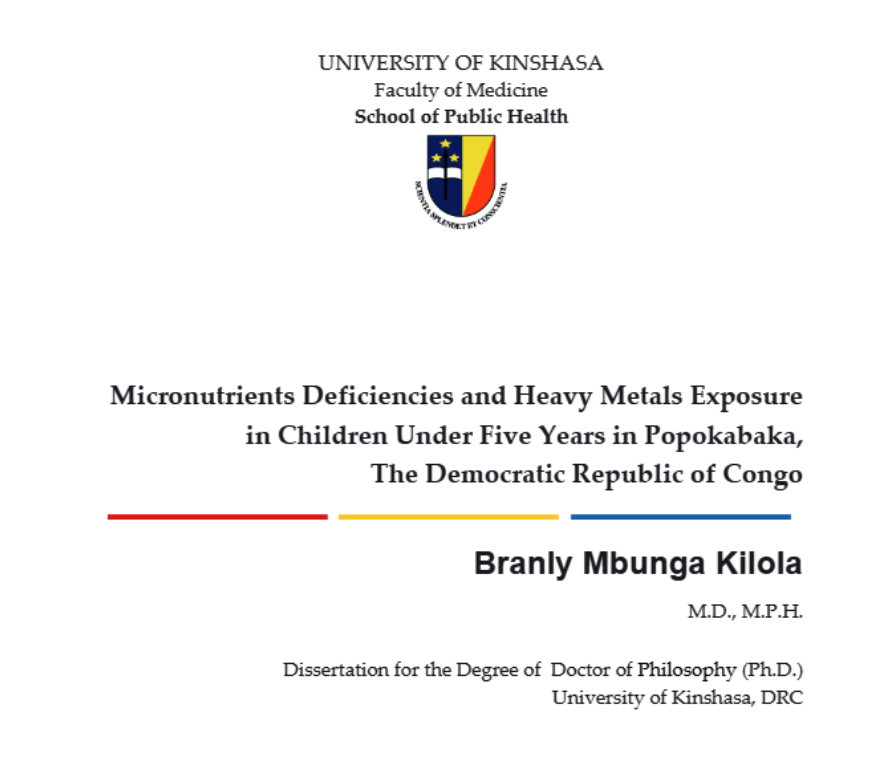
Micronutrients Deficiencies and Heavy Metals Exposure in Children Under Five Years in Popokabaka, The Democratic Republic of Congo
November 2023
DOI:10.13140/RG.2.2.34972.40322
Thesis for: PhD
Authors:
Branly Mbunga Kilola
University of Kinshasa
Abstract
Micronutrient (vitamin or mineral) deficiencies are known to lead to poor growth, poor health, cognitive impairment, and a high risk of dying from infectious diseases. The Democratic Republic of Congo (DRC) is listed among countries with a high prevalence of Micronutrient Deficiencies (MND) based on proxy estimations. However, little is known about the burden and extent of specific MNDs. Popokabaka is an example of a rural context where communities experience poor food security conditions. We aimed to measure the burden of micronutrient deficiencies, identify their Associated factors, and understand the food and nutrition context underlying MNDs to inform adapted actions and interventions in this area. We designed a mixed-method study that included a biomarker survey, market surveys, and a qualitative case study. The Inductively Coupled Plasma-Mass Spectrometry, the electrochemiluminescence immunoassay, and the immuno-turbidimetry were used in laboratories to quantify, respectively, minerals, ferritin, and C-Reactive Protein in the serum of under-five children. Different household food indicators were collected, and food consumption of micronutrient-rich food was assessed. Food availability, cost, and client satisfaction were assessed at the local markets. Drivers of food production were also explored. Children were anemic but less iron-deficient. Anemia was highly linked to inflammatory diseases. Zinc and selenium deficiencies were severely prevalent. Arsenic was detected in almost all children and quantified in high levels in half of children. Arsenic levels were statisticallyand geographically negatively linked to inverse zinc, while mercury levels were positively linked to selenium. Animal sources of foods and sea foods were under-consumed in households, rare and expensive at markets, and livestock was not developed at all. Communities preferably grow cassava, maize, and groundnuts but shared insights and perceived drivers for diversified agriculture and improved livestock. Not one but multiple MNDs should be expected to be severely prevalent and of urgent concern from Popokabaka and similar rural settings. The adapted theory of change we suggest in this thesis prioritizes the development of food-based approaches focused on livestock promotion for long stability and sustainability of good nutrition of children and all communities.
Chargement du PDF…Lecture page par page. Veuillez patienter.
Articles similaires

06/09/2023
Lire la suite →05/07/2023
Lire la suite →05/07/2023
Lire la suite →05/07/2023
Lire la suite →05/07/2023
Lire la suite →05/07/2023
Lire la suite →05/07/2023
Lire la suite →05/07/2023
Lire la suite →