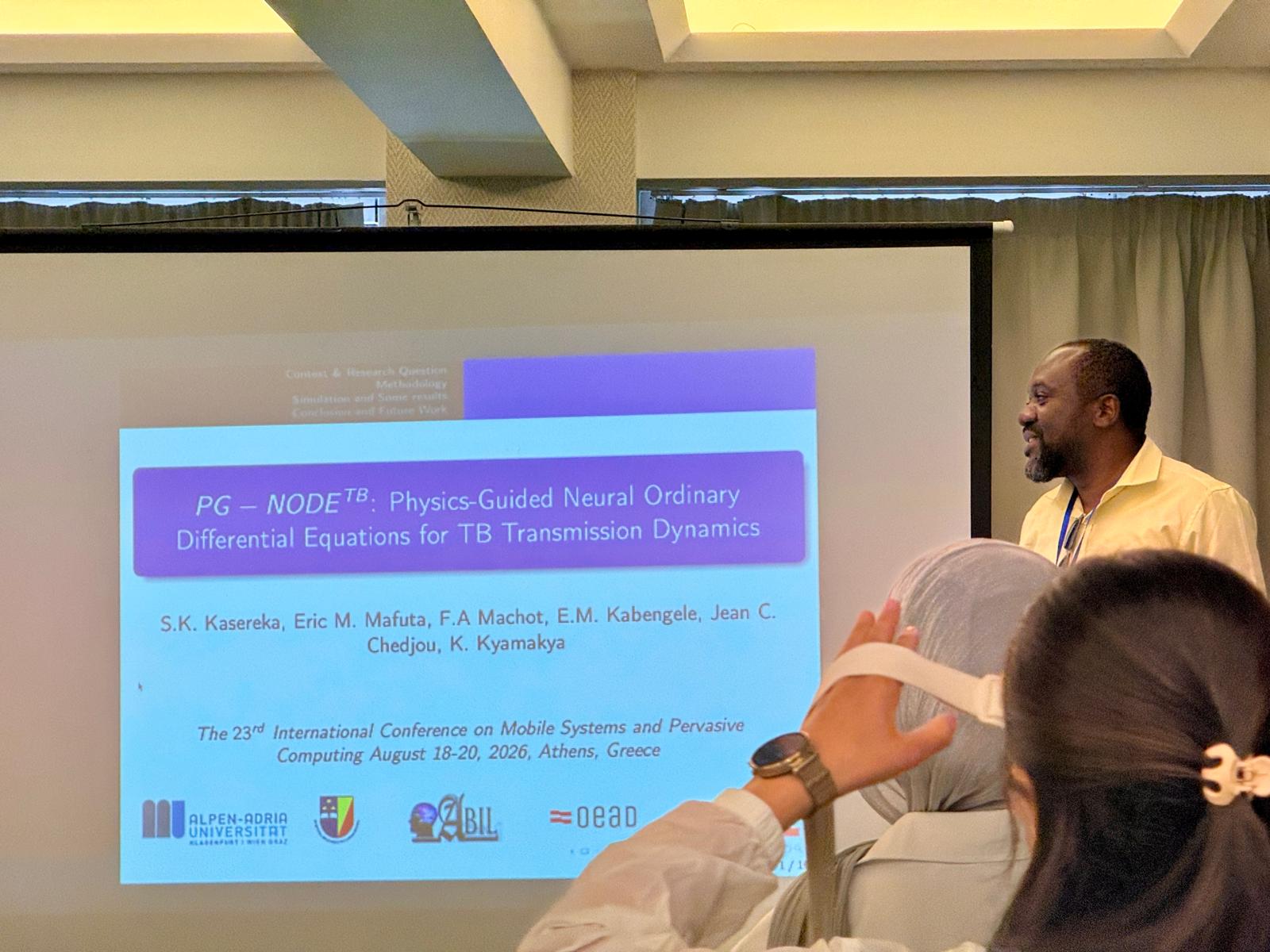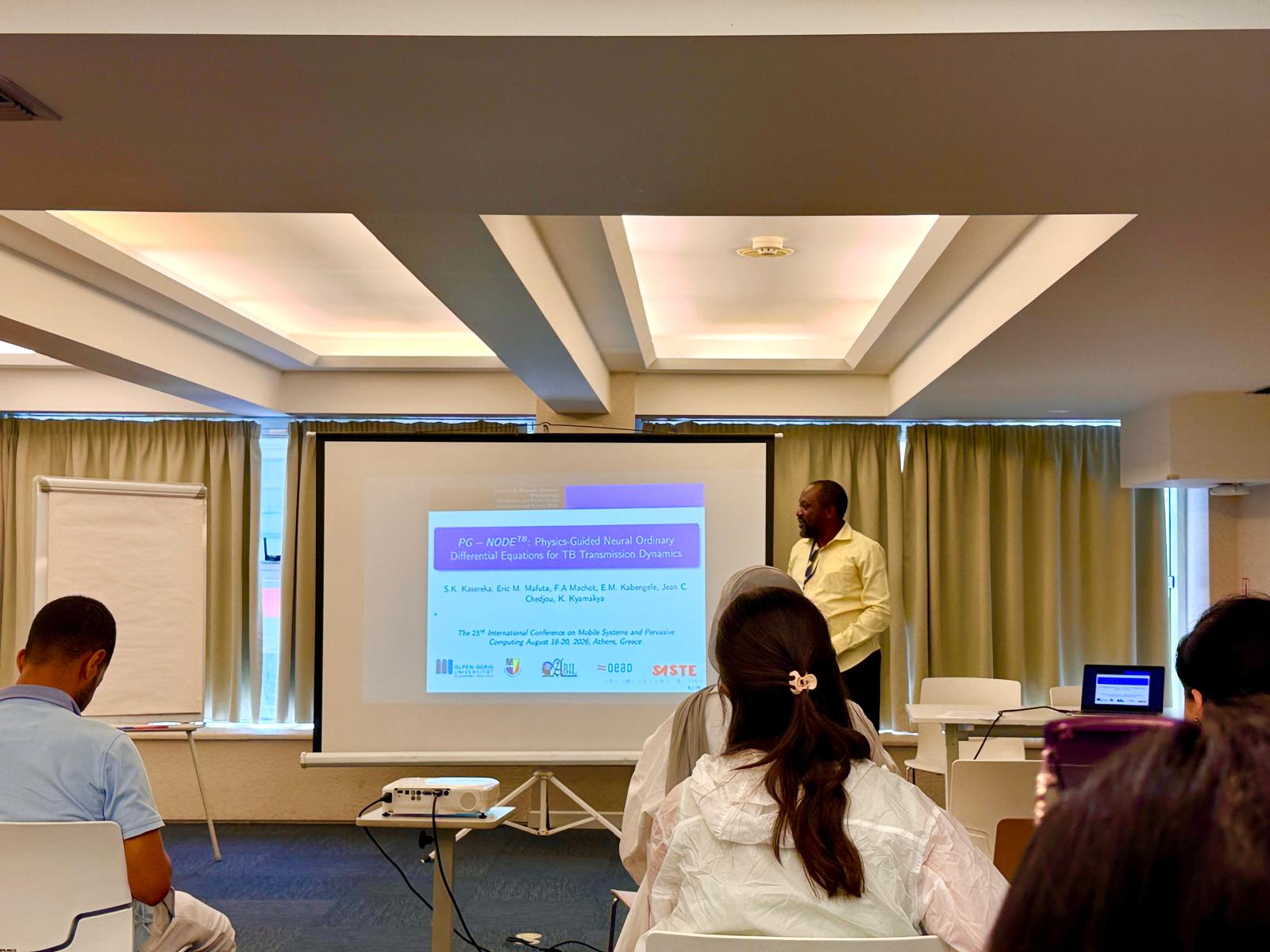
UNIKIN Shines in Athens (Greece): Prof. Selain Kasereka Presents Two Scientific Papers at the MobiSPC 2026 International Conference

Athens, Greece – August 18–20, 2026. As part of the 23rd edition of the International Conference on Mobile Systems and Pervasive Computing (MobiSPC), held from August 18 to 20, 2026, in Athens, Greece, Professor Selain Kasereka from the Department of Mathematics, Statistics, and Computer Science and the ABIL-LAB Laboratory at the University of Kinshasa presented two scientific contributions of international standing, co-authored with researchers from several renowned universities.
Published in the journal Procedia Computer Science (Elsevier / ScienceDirect), these two works illustrate the vitality of research conducted by researchers of Congolese origin on an international scale and demonstrate the scientific potential that the University of Kinshasa continues to project beyond its borders.
A Hybrid AI–Mathematics Framework to Model Tuberculosis
The first paper, titled PG–NODETB: Physics-Guided Neural Ordinary Differential Equations for Tuberculosis Transmission Dynamics, introduces an innovative framework combining physics-guided ordinary differential equations and artificial neural networks—a PG-NODE approach—to model tuberculosis (TB) transmission dynamics.
Facing the limitations of classical compartmental models, which are rigid due to their fixed-parameter structure, the authors propose an enriched SLIR model capable of learning time-varying transmission functions while preserving biological conservation laws. A rigorous mathematical analysis of the basic reproduction number (R_0), equilibrium stability, and sensitivity indices was conducted. Three simulation scenarios were examined: (i) adaptive tracking of non-stationary transmission rates; (ii) a 27% reduction in root mean square error compared to classical SLIR models; and (iii) multi-lever health policy optimization bringing R_0 down to 1.49 under combined interventions.
This work opens particularly promising prospects for connected health environments, where mobile platforms generate continuous surveillance data—a growing reality in resource-limited African countries.
The paper is co-authored by Eric M. Mafuta, Fadi Al Machot, Emmanuel M. Kabengele, Jean Chamberlain Chedjou, and Kyandoghere Kyamakya.
An Enriched Biological Model for Mpox Transmission
The second paper, titled BioMpox: A Biologically Informed Compartment Model for Mpox Transmission Dynamics, addresses the modeling of Mpox transmission—a re-emerging zoonosis whose epidemic dynamics are often poorly captured by traditional compartmental models.
The authors propose a refined SEPIRD model incorporating a pre-symptomatic progression stage and a general biological transition function ϕ(P,θ), allowing for a more realistic representation of disease progression processes. Analytically and numerically compared to a classical SEIRD model, BioMpox produces a lower and delayed infectious peak—1.15% at hour 242 compared to 12.4% at hour 68 for the classical model—representing an almost ten-fold reduction in peak infectious prevalence without altering the final attack size.
These findings have direct implications for hospital capacity planning and the design of intervention strategies in epidemic contexts, particularly in Central Africa, where Mpox remains a major public health threat.
Galerie photos