
Professors Selain Kasereka and Kyandoghere Kyamakya Honored in Athens for Organizing the International Workshop AI2M4RI 2026
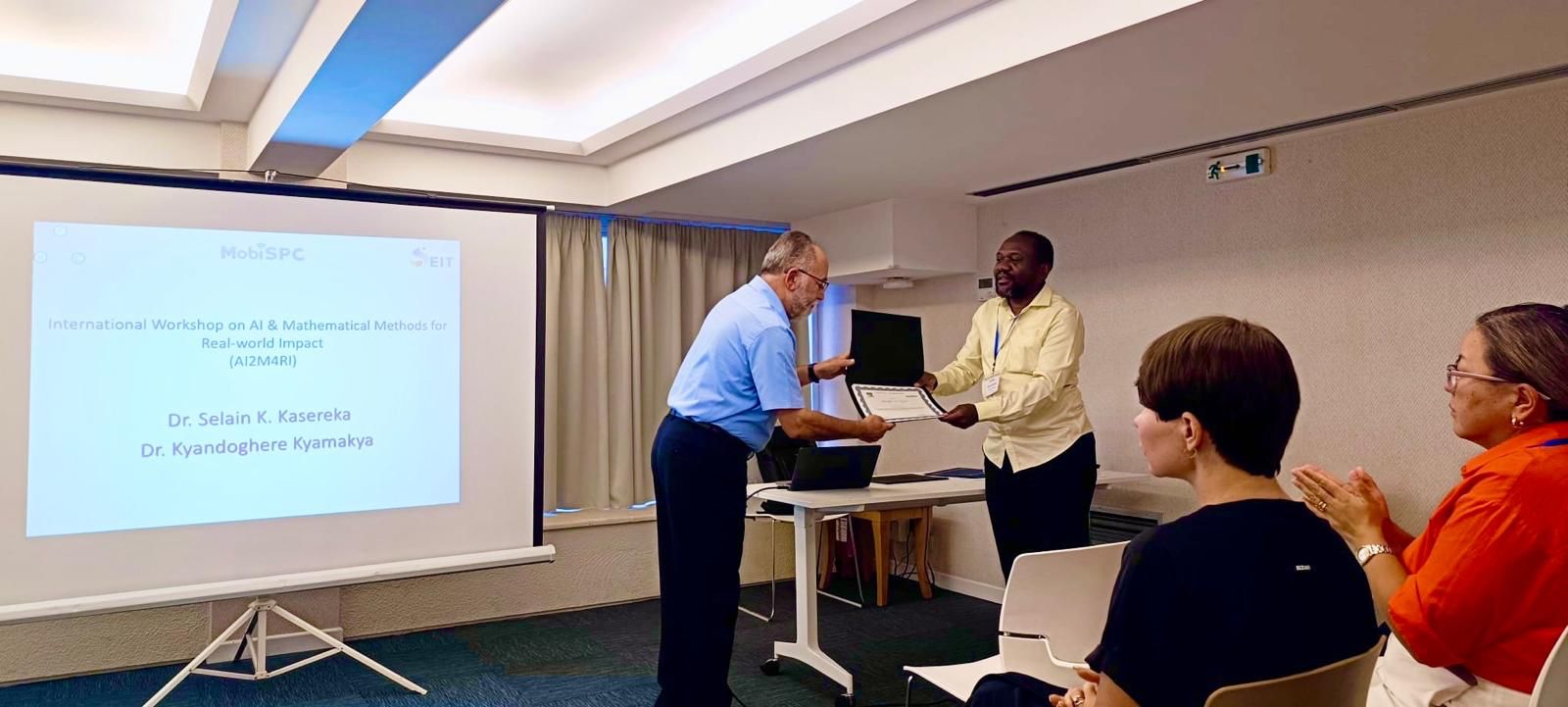
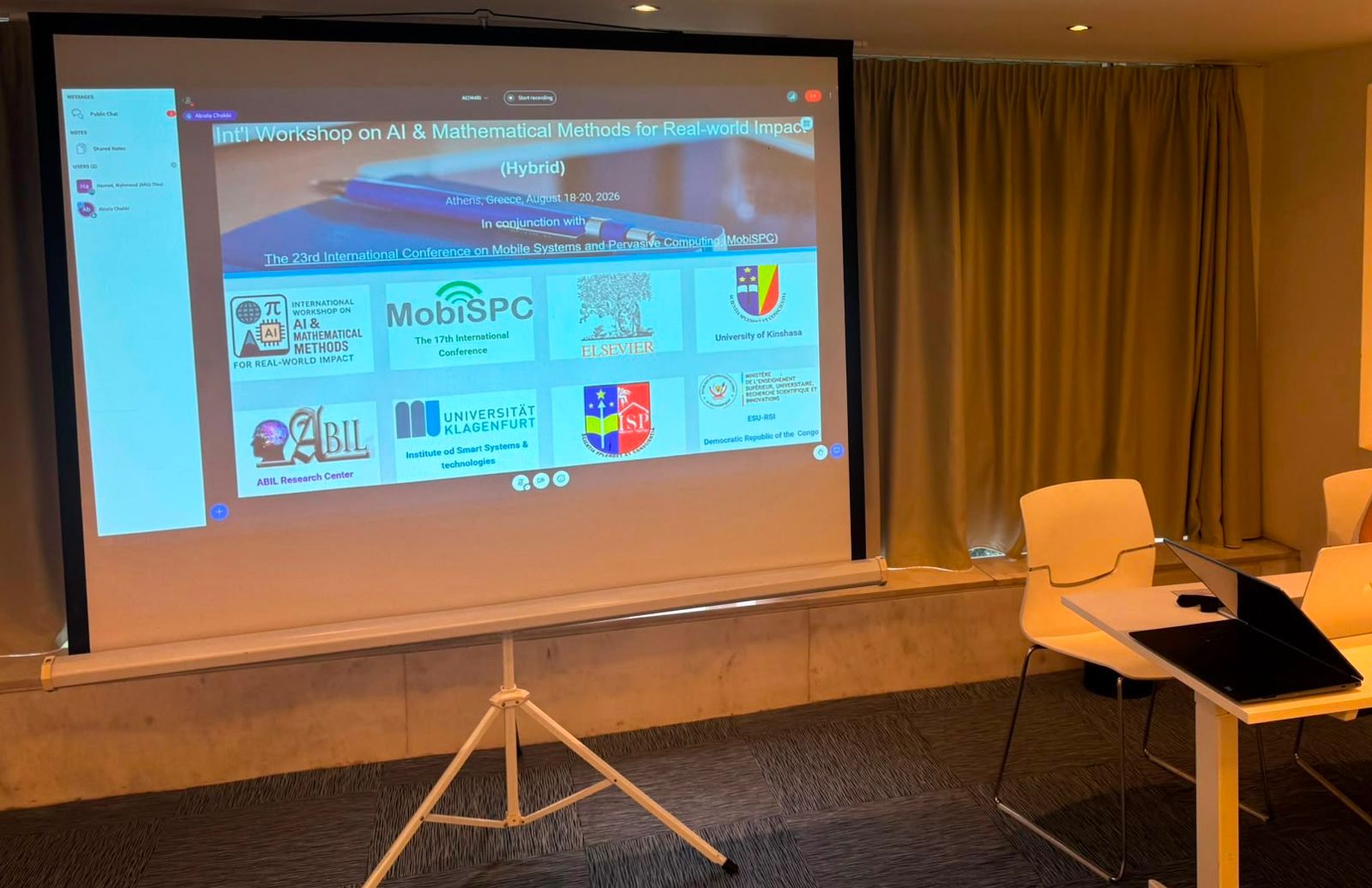
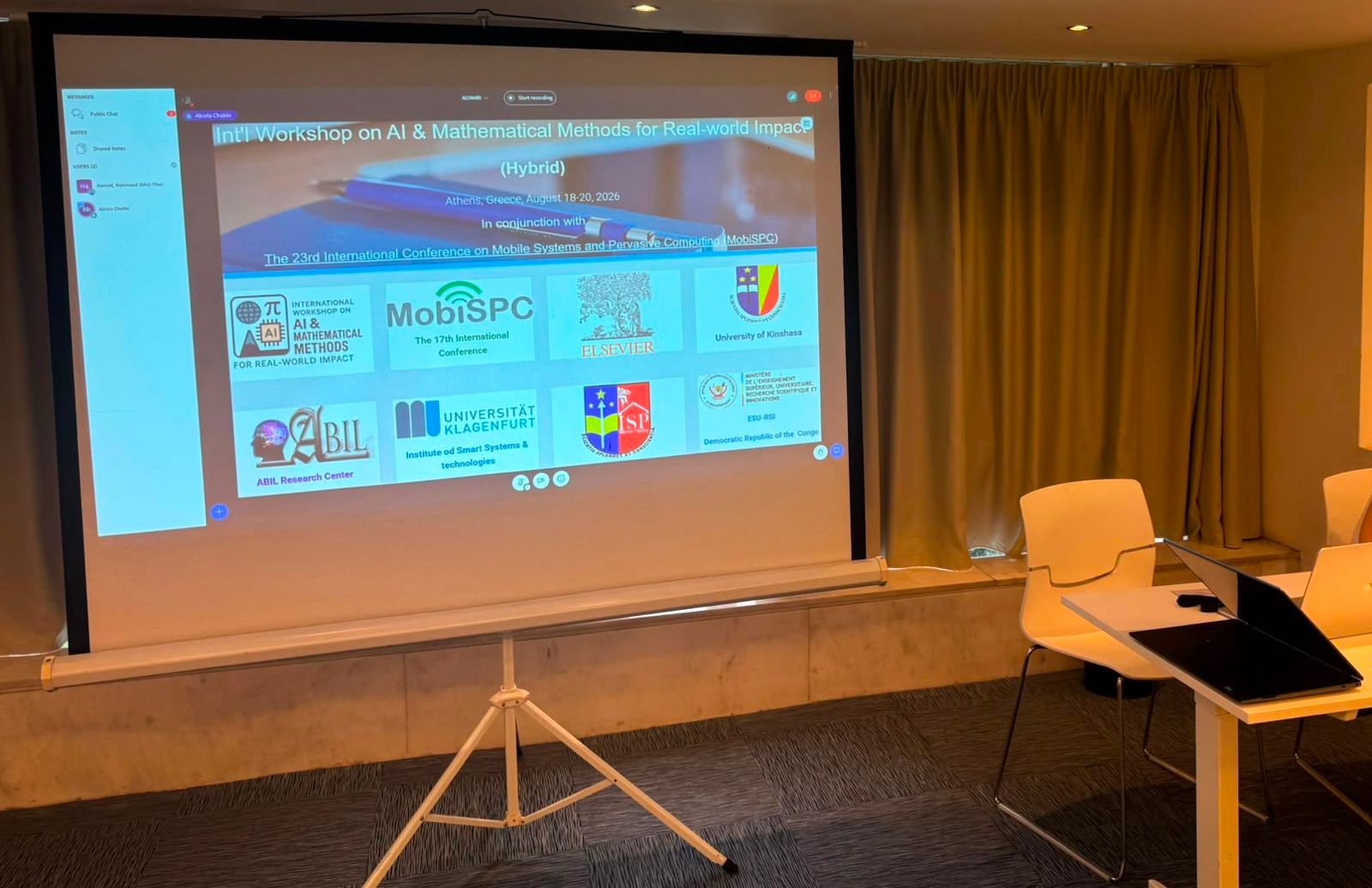
Athens, Greece – August 19, 2026. Professors Selain Kasereka (Faculty of Science and Technology) and Kyandoghere Kyamakya (Faculty of Engineering/Polytechnic) from the University of Kinshasa (UNIKIN) were honored for their contribution to the organization and success of the International Workshop on AI & Mathematical Methods for Real-world Impact (AI2M4RI 2026), held from August 18 to 20, 2026, in Athens alongside the 23rd International Conference on Mobile Systems and Pervasive Computing (MobiSPC).
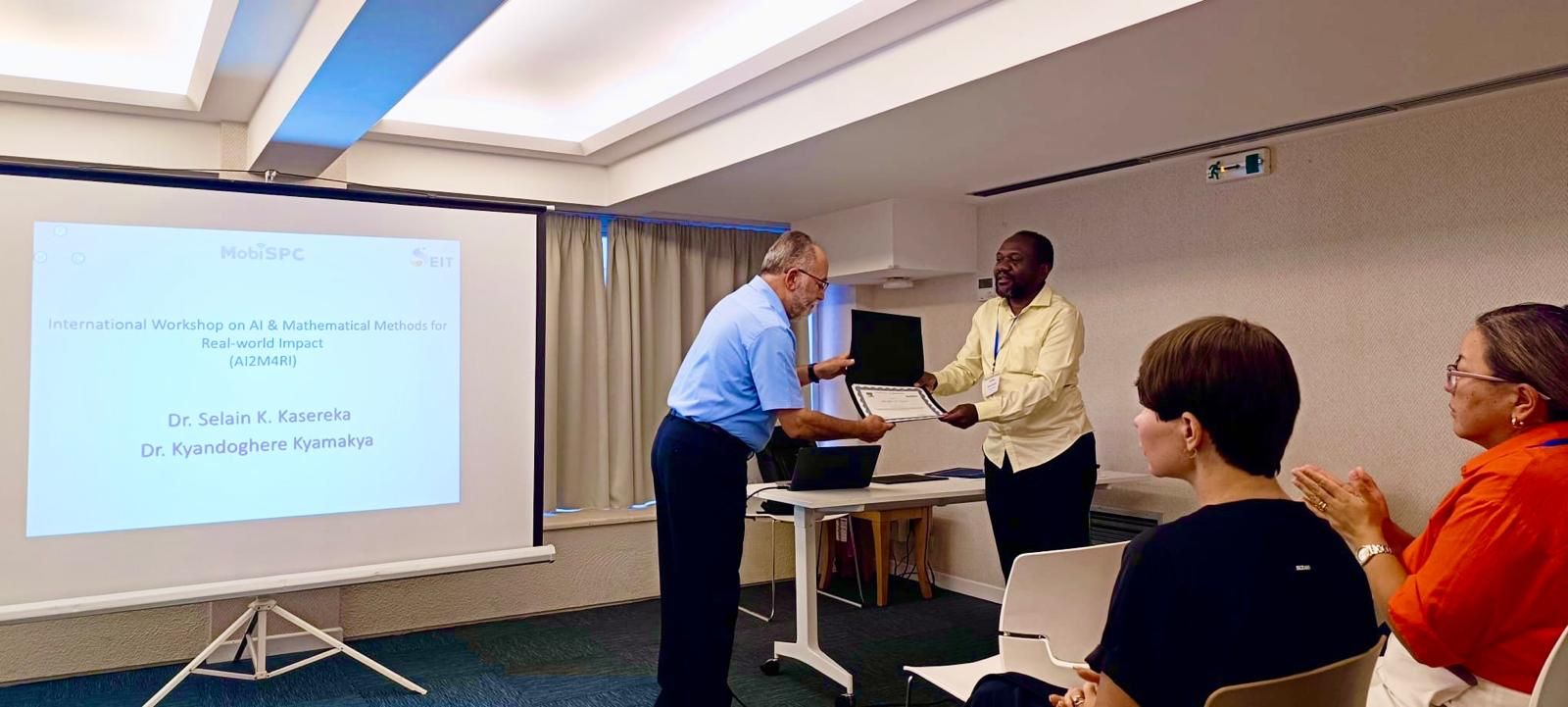
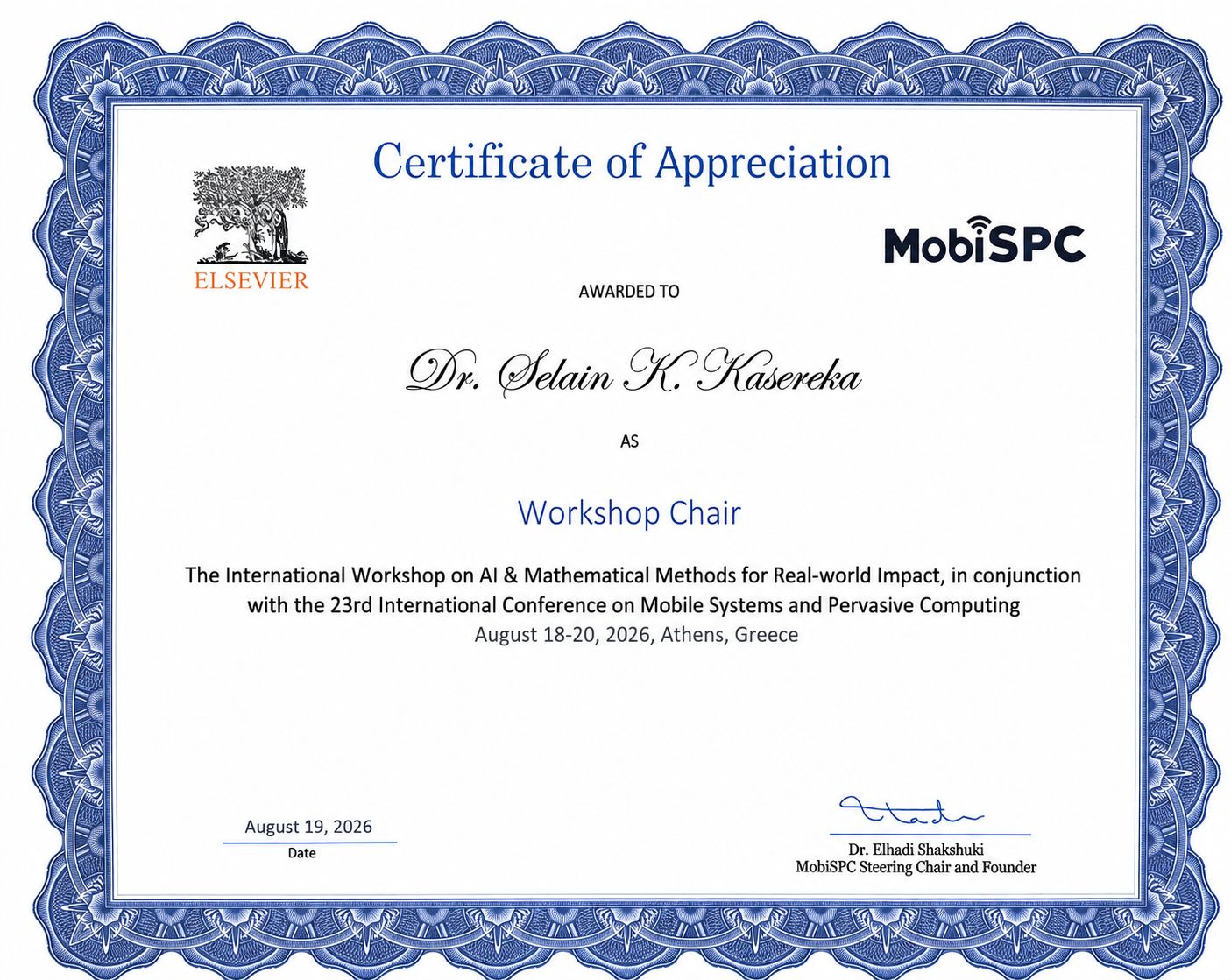
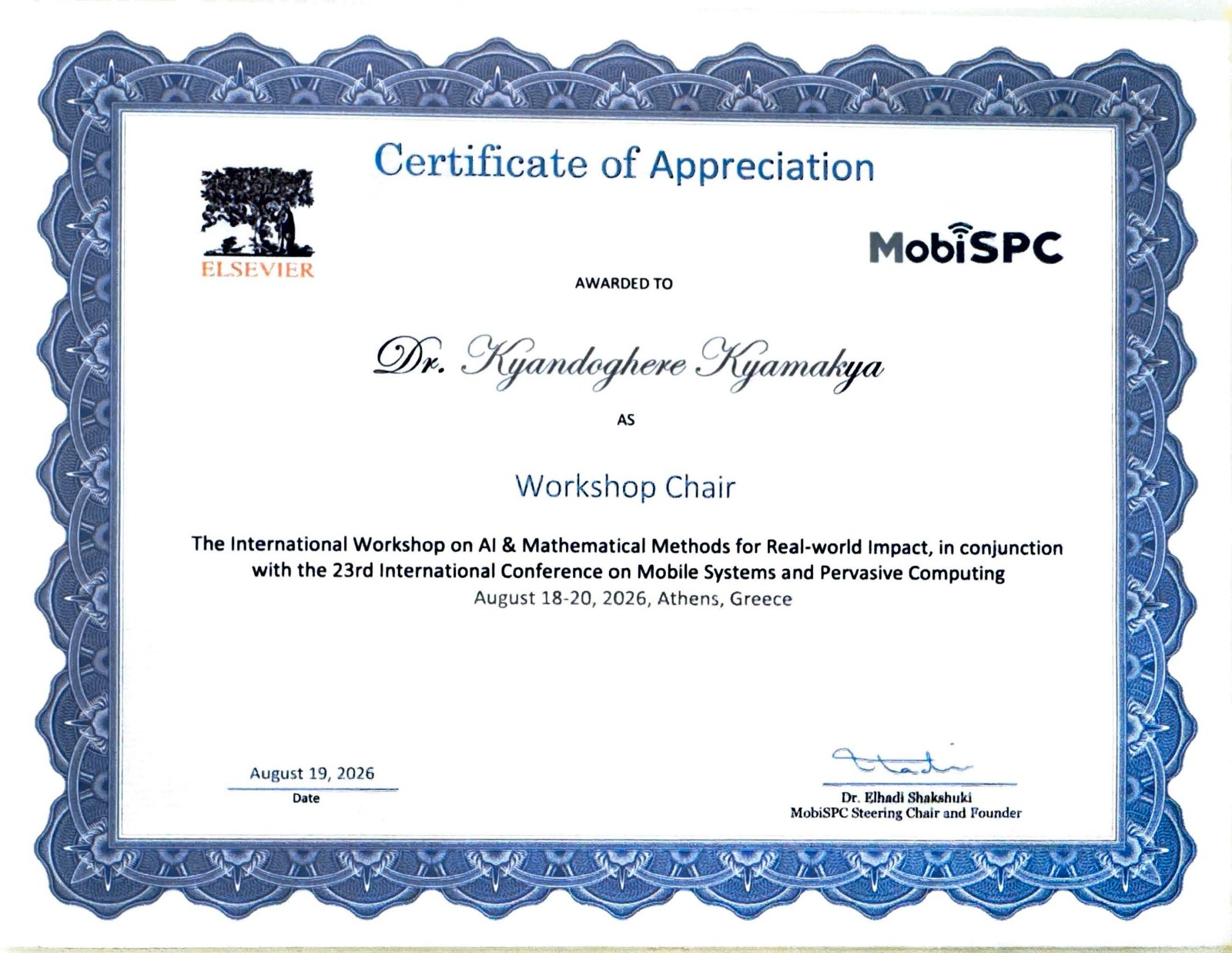
Professor Selain Kasereka received a Certificate of Appreciation in recognition of his role as Workshop Chair, alongside Professor Kyandoghere Kyamakya. This award represents international recognition of the scientific and organizational efforts dedicated to turning this gathering into a platform for dialogue and collaboration on artificial intelligence, mathematical methods, and their applications to real-world problems.
Strong Mobilization of the African Scientific Community
The AI2M4RI 2026 workshop generated remarkable scientific interest, receiving 78 submissions, 42 of which were accepted and presented following the selection process.
One of the most notable aspects of this inaugural edition was the strong participation of the African scientific community: approximately 98% of the contributions came from African researchers, reflecting the growing dynamism of African research in artificial intelligence, applied mathematics, modeling, and computational sciences.
The workshop covered several areas of strategic interest, including AI for health, environment and climate, optimization, mathematical modeling, intelligent systems, machine learning, decision systems, and AI applications in resource-constrained contexts.
Significant Challenges for Congolese Researchers
Despite this scientific enthusiasm, the participation of Congolese researchers in international events of this scale continues to face major financial constraints.
Several Congolese researchers whose papers were accepted encountered difficulties paying registration and participation fees, lacking financial support mechanisms to enable their full participation in the event.
This situation highlights the need to strengthen national support mechanisms for research and scientific mobility, particularly for early-career researchers and those from institutions with limited resources.
An Initiative Carried Out Without Public or Local Funding
It is also worth noting that the organization of this first edition of AI2M4RI took place without funding from the Government of the Democratic Republic of the Congo or any local partner, despite the scientific importance and strong African dimension of the initiative.
Professors Selain Kasereka and Kyandoghere Kyamakya spearheaded this initiative using their own means and scientific networks to build an international platform enabling African researchers to present their work and foster new collaborations.
The success of this inaugural edition demonstrates that with appropriate institutional support, such initiatives could make an even greater impact on the international visibility of Congolese research.
A Call for Greater Engagement for the Next Edition
In light of this experience, the organizers wish to launch a call to Congolese authorities, academic institutions, public research organizations, and private sector partners to pay greater attention to funding and supporting international scientific initiatives led by Congolese researchers.
The next edition of AI2M4RI is planned for 2027 in Canada, as part of the upcoming edition of MobiSPC. The organizers hope this second edition will benefit from stronger institutional and financial support from the Democratic Republic of the Congo, particularly to facilitate the participation of Congolese and African researchers and enhance the international visibility of research produced in the DRC.
For the University of Kinshasa, this experience serves as a further illustration of its researchers' capacity to initiate, organize, and lead scientific activities with an international reach.
It also serves as a reminder of an essential reality: Congolese researchers lack neither ideas, expertise, nor scientific ambition; above all, they need an institutional and financial environment that allows them to fully transform their potential into international scientific influence.
Official AI2M4RI 2026 Workshop website: https://sites.google.com/unikin.ac.cd/ai2m4ri
Galerie photos
Articles similaires
03/10/2026
Lire la suite →
29/09/2026
Lire la suite →
27/09/2026
Lire la suite →
26/09/2026
Lire la suite →
22/09/2026
Lire la suite →
21/09/2026
Lire la suite →
11/09/2026
Lire la suite →
02/09/2026
Lire la suite →